The problem
InPlayer's customers had a paywall and a way to monetize content but limited options for additional revenue streams. At the same time, in 2022, the market was moving fast on web3 and NFTs. Jefferies had forecast the NFT market would reach over $80 billion by 2025.
The Integrations team had a clear strategic goal: be first to market with a web3 solution that gave customers a new revenue stream, and use that work to demonstrate to investors that InPlayer was building in the direction the market was moving.
I framed the work internally as something broader than NFTs. The actual product was a white-label marketplace where customers could sell digital goods to their viewers, with NFTs as the first asset class and Shopify integration on the longer roadmap. Several of our customers were already selling merch: concert recordings, exclusive content drops, merchandise tied to live events. A marketplace they could brand themselves was a natural extension of what they were already doing.
This framing protected the work from being tied entirely to web3 hype. Even if NFTs faded as a category, the marketplace infrastructure would still be valuable.
Discovery — two parallel tracks
Discovery ran in two parallel tracks, because we were dealing with scepticism on two fronts: customers were curious but cautious about NFTs, and internally, not everyone believed web3 was anything other than hype.
Track one: customer interviews. The product designer and I spoke with three customers from different segments: a platform-apps company, a sports media company, and a music-industry production company. The customers were curious, but none had NFT experience themselves.
"A hot topic, very early stage."
"We want to stay with the curve — definitely interested in testing."
Their responses told us they wanted to stay on the curve. But the way they spoke, the hesitations, the uncertainty, made clear they didn't know enough about the space to engage with the specifics. They could say yes. They couldn't tell us much beyond that.
Track two: NFT practitioners. So I opened a second track. I reached out to people I didn't know personally but had learned had real experience with NFTs: artists who'd minted collections, people who'd bought and traded, people who lived in the NFT communities on Discord and Twitter.
These conversations were where the texture came from. They told us what motivated NFT buyers (ownership, community access, investment), which marketplaces dominated and why, what payment preferences looked like, and what NFT communities actually valued. One practitioner walked us through the entire flow of minting a collection, building a community and pricing the work. That single conversation was worth ten generic customer interviews.
The financial case
I worked on the financial and strategic case in parallel with discovery. The timeline was tight and the financial story needed to be ready alongside the product. Three things mattered.
TAM. I anchored on the Jefferies $80 billion forecast and ran a share analysis against InPlayer's customer base.
ROI model. I built this in a spreadsheet using the 4-month build cost. Across all involved stakeholders, engineering, product, design, security, finance, the total project cost came to just under $80,000. I modelled a 5% platform transaction fee on an average NFT price of $161, plus creator royalties. At 10,000 viewers buying NFTs, ROI was –70%. At 200,000 viewers buying, ROI hit 510% — strong for most businesses, exceptional territory.
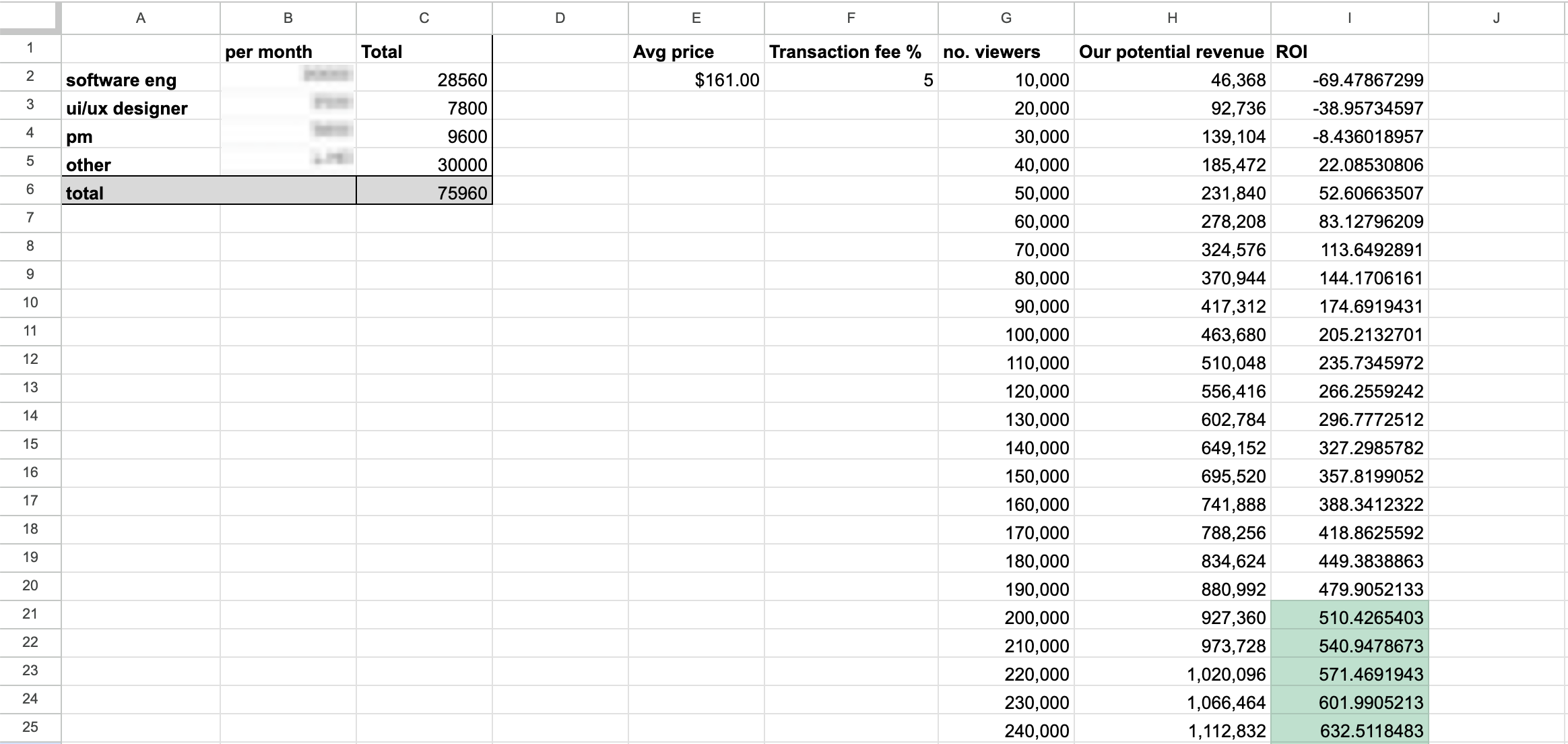
Customer math. Working backwards from that 510% figure: we'd need 200,000 viewers buying across the customer base. Based on InPlayer's typical customer size, that meant at least 4 customers using the marketplace. I took this analysis to the CPO and used it to anchor the conversation about how many launch customers we needed to sign.
Building across the whole company
The 4-month build touched every part of InPlayer. Engineering built the smart contract and minting infrastructure. Security ran the smart contract audit, wrote the security whitepaper, and worked through KYC/AML and geographic compliance requirements, crypto is illegal in some countries, which mattered for how we restricted access. Finance worked through the wallet hierarchy for handling crypto and fiat. Design built both the customer dashboard and the viewer-facing marketplace.
My job during this phase was less about producing artefacts and more about keeping the work moving. Two parts were hardest.
Internal scepticism. Not everyone in the company believed in NFTs, including some of the engineers building the smart contracts. My job wasn't to convince them NFTs would change the world. It was to anchor on the strategic outcome we were actually trying to achieve: first-to-market positioning and investor confidence, not betting the company on web3. The white-label framing helped. So did the financial analysis. When sceptics could see we were building white-label marketplace infrastructure that would survive even if NFTs didn't, the conversations got easier.
Knowing when to step back. The minting workstream: smart contract templates, wallet hierarchies, gas fee management, AWS KMS for key storage, Polygon blockchain integration, EIP-721 compliance, was owned end-to-end by an engineering lead. My role was to make the product and customer experience requirements clear, then get out of the way. I spent my time on the strategic and customer-facing layer instead.
Usability testing and the investor demo
We ran usability testing internally with two people from Account Management, the closest thing to the actual product buyer we had inside the company. We used a clickable prototype covering the full flow: creating a marketplace and minting NFTs on the dashboard side, and browsing, buying and in-stream purchase on the viewer side. They rated the buying flow at 4 to 5 out of 5. We made specific changes before the demo, clearer field labels, better guidance on gas fees, a cleaner two-phase draft-and-publish flow.
The timeline was driven by the investor pitch, so we made a deliberate choice not to run external customer validation before the demo. The trade-off: we'd be shipping a product whose viability with real customers we hadn't tested externally. The strategic upside of hitting the pitch with a working product was worth it. If the project had continued to a customer launch, external validation would have been the next thing on my list.
I demoed the marketplace to investors alongside the CPO. The CPO led the pitch; I ran the demo. The audience was quiet, which I learned afterwards is normal for investor demos. They were watching, taking notes, not reacting in the moment. The pitch went well. We told the story we wanted to tell, and we showed a working product.
Acquisition
Shortly after the investor pitch, InPlayer was acquired by JWX and the marketplace project was paused. We'd spent 4 months building something genuinely ambitious, the most ambitious thing I'd worked on at InPlayer, and it got InPlayer to be acquired.
The work achieved its primary strategic goal: supporting InPlayer's positioning at a critical moment. It didn't get to achieve its secondary goal of becoming a customer-facing revenue stream.
Find the version of the work that's true even if the sceptics are right
I'd never pushed a project forward against this much internal doubt before. What I learned was that the answer isn't to convince sceptics I'm right, but it's to find the framing of the work that holds even if they are. The white-label marketplace framing did that. Whether NFTs survived as a category or not, we'd have built something useful. The roadmap protected the work from the hype cycle. That's a framing skill I've reached for many times since.
Investor audiences are fundamentally different
The pressure is significantly higher than any audience I'd presented to before. If I were doing this again: I'd research the specific investors, build a story around what they care about, co-plan the demo and pitch with the CPO so the through-line is tighter, and lead with the financials, not the user experience, because investors are evaluating ROI first.
Delegation is a skill, not a shortcut
Earlier in my career I would have tried to learn the smart contract work deeply enough to drive the conversations myself. On this project I made a different choice. I trusted the engineering lead to own the technical layer and spent my time on the strategic and customer-facing work. That was the right call. Knowing when to step back from technical detail and let the right person own it is something I keep practising.